

Your child still finishes Senior High School. Grades 11 and 12 are not going away, and the diploma is still a Senior High School diploma. What is changing is what sits inside those two years — the subjects, how they are packaged, and how much time goes to hands-on work.
That is the short answer to the question most parents are actually asking when they hear "new SHS curriculum" at an open day. The longer answer matters too, because the details decide whether the school you are about to pay a reservation fee to is really ready.
This post is a change log, not a policy summary. It walks through what is different area by area, flags the parts only your school or DepEd can confirm, and ends with the exact questions to send before you enrol.
The five things to know
- K-12 stays. The strengthened curriculum revises content inside the existing structure; it does not remove Grades 11–12.
- SY 2025-26 is a pilot for Grade 11 only, in pilot schools — not a nationwide switch.
- Core subjects drop from 15 to 5, but each one carries about 160 instructional hours. Fewer subjects is not a lighter week.
- Electives are chosen by the learner from what the school actually offers — availability is school-specific.
- Field exposure is 160–320 hours in one semester. Ask who arranges the placement and what your family pays for.
What "strengthened SHS" means, and who it actually affects
The worry behind the question is usually practical: will colleges and employers still accept my child's SHS record? Start with the legal floor, because it settles the biggest rumour. Republic Act 10533, the Enhanced Basic Education Act passed in 2013, still requires at least one year of kindergarten, six years of elementary and six years of secondary education — four years of junior high plus two years of senior high (Official Gazette of the Republic of the Philippines, 2013). DepEd designs the curriculum within that framework. A curriculum revision is not a repeal of K to 12.
The issuance behind the change is DepEd Memorandum DM 048, s. 2025, titled "Pilot Implementation of the Strengthened Senior High School Curriculum for Grade 11 in School Year 2025-2026". The final list of pilot schools was released through Joint Memorandum No. OM-OSEC-OUOPS-2025-01-03469.
Read that title carefully, because it answers the "who does this affect" question:
- Grade level: Grade 11 only for SY 2025-2026.
- Coverage: pilot schools, not every school in the country.
- What comes next: according to DepEd's official Strengthened SHS Program page, all Grade 11 SHS learners will be under the strengthened curriculum starting SY 2026-2027.
So if your child is entering Grade 11 this year at a school that is not on the pilot list, they are most likely still running the older curriculum. If your child is already in Grade 12, ask the school directly which curriculum their remaining subjects fall under and get the answer in writing — that transition detail is one to confirm with the school or your DepEd division office rather than assume.
Track-by-track detail lives in our Senior High School Tracks & Strands guide. Here we stay on what changed.
Change 1 — the subject load and how the school year is organised
The headline change is the core. Under the strengthened curriculum, core subjects are streamlined from 15 down to 5, as set out in DepEd's SSHS Key Features (2025):
| Core subject |
|---|
| Effective Communication / Mabisang Komunikasyon |
| Life and Career Skills |
| General Mathematics |
| General Science |
| Pag-aaral ng Kasaysayan at Lipunang Pilipino |
Language, mathematics and science are still there — they are simply consolidated into fewer, broader subjects rather than dropped. Core subjects are fully delivered in Grade 11.
Fewer subjects, not fewer hours
Here is the trap. Each core subject is scheduled one hour per day, four days per week, for one school year — roughly 160 instructional hours per core subject, per the same DepEd Key Features document. Five subjects at that weight is a substantial weekly load, not a slimmed-down timetable.
Figures from DepEd's SSHS Key Features (2025), cited above and below.
The overall load depends on the pathway. Per DepEd's updated SSHS Key Features (2026), learners take roughly 7 to 23 subjects:
| Pathway | Structure |
|---|---|
| Academic Track | 5 core subjects + at least 9 electives, totalling 960 hours |
| Technical-Professional Track | 5 core subjects + at least 2 TechPro electives, totalling 640 hours, plus work immersion |
Ask for hours, not just a subject count
A brochure that says "only 5 core subjects!" is describing packaging, not workload. Ask for weekly contact hours per subject and the total hours per year. That is the number that tells you whether your child's week is heavier or lighter than before.
Practical step: request the school's curriculum map — subjects, hours, and the sequence across the year — and check it against the official DepEd list above. How a particular school organises its calendar (whether subjects run in semesters, quarters or blocks) is something to confirm with that school; do not accept "new curriculum ready" as an answer.
Change 2 — tracks, strands, and electives
This is where a familiar name can mislead you. Under the strengthened program, learners choose electives based on their interests and goals, and may take electives from any cluster offered by their school — including clusters outside their chosen track. Availability depends on what the school offers, as stated in DepEd's 2026 SSHS Key Features.
Two consequences follow for parents:
- A strand name on a 2025 brochure may not carry the same subjects it used to. It is worth asking for the actual subject list behind the label rather than trusting the name alone. Marketing materials do not always get rewritten the moment a curriculum changes.
- Availability is school-specific, not national. A campus can only run the electives it can staff and equip. Two schools advertising the same direction may offer very different sets of subjects behind it — and a school may promote a strand it is not authorised to offer at that campus.
If your child later wants to shift direction after Grade 11, ask the school what that would cost in time and any additional subjects. That is a school-level and policy-level detail worth getting in writing before you commit, not something to assume is free or automatic.
Still weighing STEM against ABM, HUMSS, GAS or TVL? Our tracks and strands explainer covers what each direction involves so you can compare them properly.
Change 3 — work immersion, industry exposure, and certification
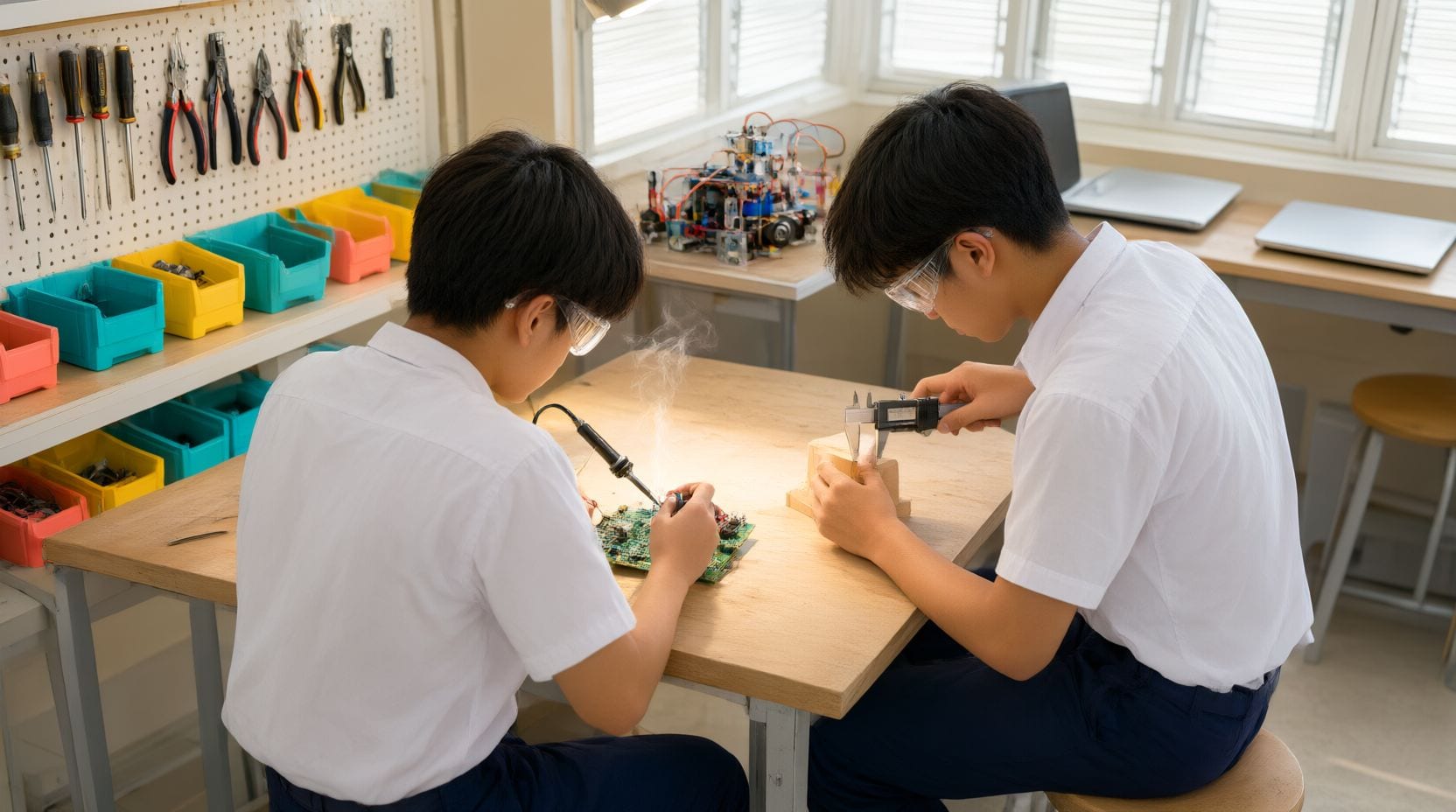
Hands-on work becomes a bigger, more formal part of Senior High School. DepEd's SSHS Key Features (2025) lists Field Exposure of 160–320 hours in one semester under the strengthened program. In the Technical-Professional Track, work immersion sits alongside the TechPro electives in the subject-load structure described earlier.
That range is wide, and the difference between 160 and 320 hours is real time out of your child's year — plus real logistics for your family. Which end of the range applies, where the hours sit in the calendar, and how placements are arranged are things to confirm with the school itself.
What to put to the school
- Who finds the placement — the school through its industry partners, or the family?
- What the family pays for — transport, uniform, medical requirements, any immersion fees.
- How hours are logged and verified, and what happens if a placement falls through.
- What document the student receives at the end — a certificate of completion, an assessment result, or something else.
- Safety and consent arrangements for off-campus work involving minors: parental consent, supervision, insurance.
For TVL families: verify the certificate, not the label
A certification claim is only useful if the school is an accredited assessment venue or has a named partner that can assess the qualification. Ask which specific qualification your child can actually be assessed for at that campus, and what proof they walk away with. A strand name is not a credential.
Change 4 — what it means for college admission and job applications
Some background helps here, without overreading it. Back in 2013, CHED's revised General Education Curriculum under CMO No. 20, s. 2013 removed remedial courses and subjects that duplicated Grades 11–12 (Commission on Higher Education, 2013). That is context on how SHS and college general education were designed to fit together — it is not a CHED statement about the strengthened curriculum.
Two rumours to ignore
"The new curriculum guarantees college credit" and "the new curriculum guarantees employment" are the claims parents act on fastest. Neither should drive a track decision without written confirmation from the receiving institution or employer. Treat both as unverified until someone who decides admissions or hiring puts it in writing.
If your child is college-bound: ask the target university's admissions office — not only the SHS — whether the prerequisite subjects for the intended course are still complete under the school's new subject map. Mathematics and science sequences matter for engineering and health-related courses. The SHS can tell you what it teaches; only the receiving institution can tell you what it accepts.
If your child is work-bound: ask employers or the industry partner what they actually require — a specific certificate, a number of logged hours, a portfolio — then check the school's answer against that requirement.
The questions to ask your school before you enrol
Copy this list into an email or bring it to your campus visit. Ask for the answers in writing.
- Which curriculum will you run for Grade 11 in SY 2025-26 — the strengthened curriculum or the previous one?
- Are you a pilot school, or will you implement nationwide in SY 2026-27?
- Which tracks, strands or elective clusters are approved for this campus?
- Can I see the subject map, with weekly contact hours per subject and the sequence across the year?
- Can I see the work immersion or field exposure plan — hours, placement arrangements, costs and the document issued at the end?
- What happens to my child if the school changes implementation mid-year?
- Will you confirm all of the above in writing — email, signed brochure, or enrolment terms?
Before you pay any reservation fee, verify the school's DepEd recognition or permit for senior high school, and for the specific strand or programme being sold to you. A curriculum change is exactly the moment when outdated marketing circulates. Our guide on how to check if a school is DepEd-recognized walks through the verification steps.
On funding: whether SHS voucher amounts or eligibility shifted alongside the curriculum, and what authority a private or non-DepEd provider needs to run the strengthened program, are questions to put to the school and to PEAC rather than assume. Our ESC and SHS Voucher Program guide explains how the support works — ESC for eligible private junior high students, and the SHS Voucher administered through PEAC.
Verbal assurances are not a commitment
An open-day promise about fees, immersion costs or strand availability is not binding. Ask for it in an email, a signed brochure, or the enrolment terms — especially anything involving money.
What to do this month
- 1
Confirm implementation status in writing — email each school on your shortlist and ask which curriculum it will run for Grade 11 in SY 2025-26, and whether it is a pilot school.
- 2
Get the subject map for every direction your child is considering — subjects, weekly hours, sequence, and the elective list actually available at that campus.
- 3
Check the endpoint — confirm prerequisite subjects with the target college's admissions office, or the required credential with the target industry or employer.
Then step back and reframe the decision. The curriculum changes the packaging of Senior High School. It does not change the basis for choosing it: your child's interest and aptitude, the quality of the teaching and facilities, the commute, and the total cost in pesos still decide fit.
You can read the policy yourself on DepEd's official Strengthened SHS Program page. Implementing rules and school-level details may still be released, and we will update this post as they are confirmed. Until then, treat social-media summaries as unverified — including the confident ones.
If your child is still choosing a direction, start with our guide on how to choose an SHS track for your target college course.
Shortlist schools offering the direction your child wants
Answer a few questions about your child, your area and your budget, and get a shortlist of nearby public and private schools. Free for parents, with no paid placement in the results.
Find a school that fitsSources
- Department of Education (DepEd) — DM 048, s. 2025, Pilot Implementation of the Strengthened Senior High School Curriculum for Grade 11 in SY 2025-2026 (2025)
- Department of Education (DepEd) — Strengthened SHS Program (2025)
- Department of Education (DepEd) — SSHS Key Features (2025)
- Department of Education (DepEd) — SSHS Key Features, updated (2026)
- Official Gazette of the Republic of the Philippines — Republic Act No. 10533 (2013)
- Commission on Higher Education (CHED) — Statement on Filipino and the revised General Education Curriculum, CMO No. 20, s. 2013 (2013)
