Daycare / Child Development Centre
- Typical ages
- Toddlers to pre-Kinder
- Part of DepEd K to 12?
- No
- Who runs it
- Often barangay/LGU (with DSWD/ECCD support); some private
- Main purpose
- Supervised care, early stimulation, socialisation

In the Philippines, Kindergarten is the official first year of DepEd's K to 12 program — it is required before Grade 1 and is free in public schools. Daycare, nursery and preschool come before Kindergarten: they are optional, usually run by private providers or by the barangay/LGU, and they are not part of the DepEd K to 12 ladder. This guide explains the differences, the ages, what enrollment looks like, and how to choose the right early-years setting for your child.
Kindergarten Official start of K to 12. Required before Grade 1. Free in public schools.
Preschool / Nursery Optional, mostly private. Play-based learning before Kinder.
Daycare / Child Development Centre Often barangay/LGU-run. Care-focused, younger ages.
Free for parents · Listings based on the DepEd school masterlist and public Google Maps data · No paid placement in results.
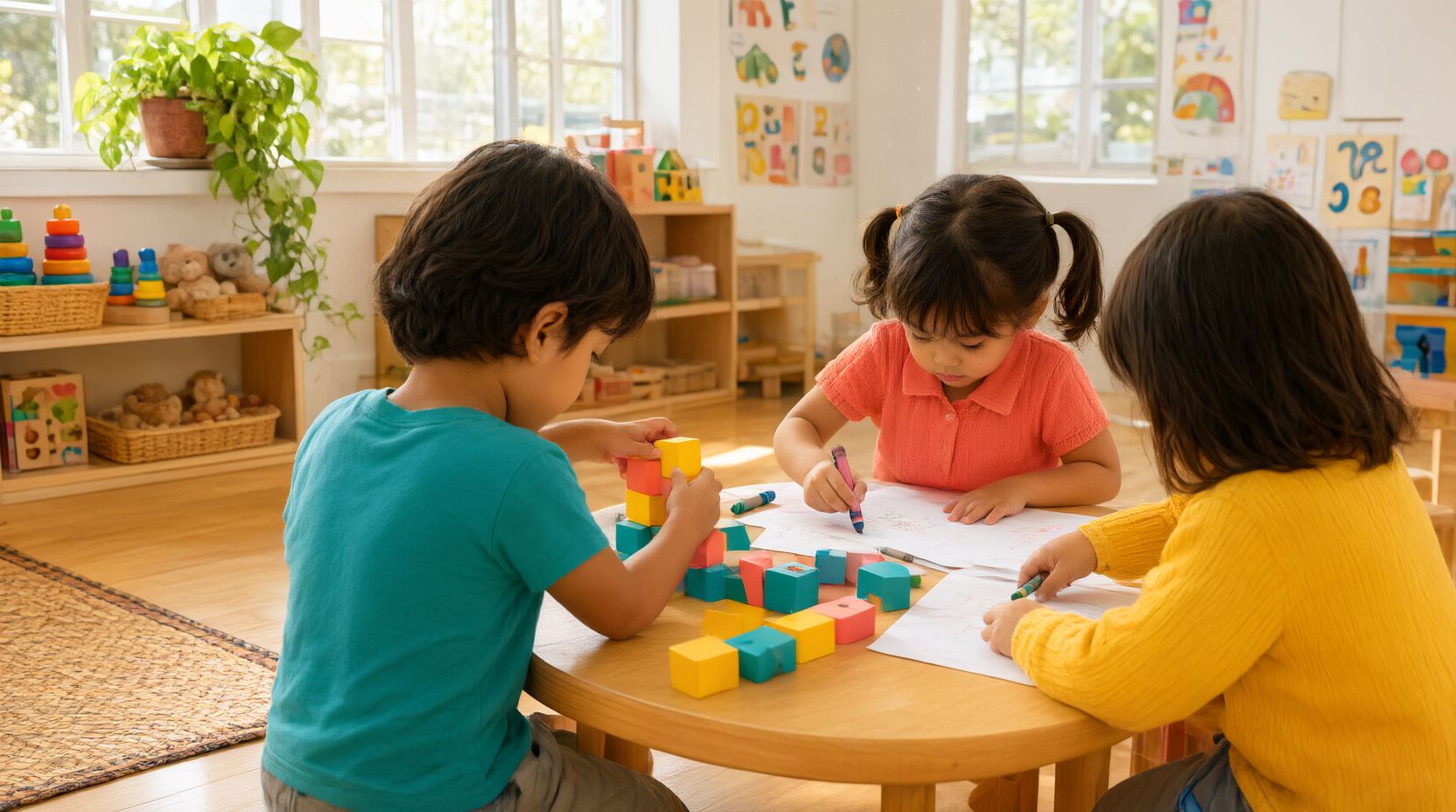
The main differences are age, purpose, and whether the program is part of DepEd's K to 12 ladder.
| Setting | Typical ages | Part of DepEd K to 12? | Who runs it | Main purpose |
|---|---|---|---|---|
| Daycare / Child Development Centre | Toddlers to pre-Kinder | No | Often barangay/LGU (with DSWD/ECCD support); some private | Supervised care, early stimulation, socialisation |
| Nursery | Around 2–3 | No | Mostly private | Gentle first separation, routines, play |
| Pre-Kindergarten / Preschool | Around 3–4 | No | Mostly private; some attached to a bigger school | School readiness through structured play |
| Kindergarten | Around 5 (see age rule below) | Yes — first year of K to 12 | Public (DepEd) and private | Required foundation year before Grade 1 |
A Learning & Enrichment Centre — tutorial, language, music, dance, art, martial arts or swimming, coding and STEM, daycare and after-school care — is a different category from a school. Those providers live in our centres directory, not in the school listings.
Kindergarten is the required foundation year before Grade 1 under DepEd's K to 12 program. Children normally enter Kindergarten around age 5 and move on to Grade 1 the following school year — but the deciding factor is not the age you assume, it is the cut-off DepEd publishes for that school year.
Verify before you planDepEd sets an age cut-off for incoming Kindergarten and Grade 1 each school year, and it publishes the exact date in its enrollment issuance for that year. Children who miss the cut-off are typically advised to wait for the next school year or continue in preschool. Confirm the current cut-off with the school or your DepEd division office, and check the latest DepEd enrollment issuance at deped.gov.ph before you plan around a birthday.
Dashed = optional, outside K to 12 · Solid = DepEd K to 12
Many private schools accept preschoolers well before the public Kindergarten age. That is why one child can be "in school" for two or three years before Kindergarten officially begins, while another starts at Kindergarten itself — and why two families with the same age child can have very different budgets. Neither path is wrong; the required year is Kindergarten.
Both sectors can deliver Kindergarten. What differs is who runs it, what you pay, and what is available below Kindergarten.
Neither sector is automatically the better choice. Fit, commute, schedule, cost and the people caring for your child matter more than the label on the gate. On Skoolopedia, paid or premium profiles do not change search ranking or recommendations.
Public Kindergarten follows DepEd's Kindergarten curriculum. Below Kindergarten, and in private schools, you will see a mix of approaches — some are formal methods with teacher training behind them, others are the school's own blend. Ask what a normal day looks like, how teachers are trained, and how progress is shared with you.
Learning is organised around play, stories, movement and hands-on materials, with skills built through guided activity.
Ask: "How do you track what my child is learning through play?"
Mixed-age groups, child-chosen work from a prepared set of materials, and long uninterrupted work periods.
Ask: "How much of the day is child-chosen work, and how are teachers trained?"
The term is built around themes that connect early literacy, numeracy, art and motor skills.
Ask: "Can I see a sample weekly plan?"
Project-led or rhythm-and-imagination-led settings that draw on those philosophies without necessarily being formally affiliated.
Ask: "What is inspired by the approach, and what is formally affiliated?"
Values formation and religious activities are part of the daily routine.
Ask: "Which activities are required, and how are children of other backgrounds included?"
A deliberate mix of languages across the day, sometimes with a dedicated language period.
Ask: "Which language is used for instructions, for stories, and for comfort when a child is upset?"
Ask which languages are used through the day — Filipino, English, a regional language, or a mix — and how teachers support a child who is still building confidence in the classroom language. For public schools, check the latest DepEd issuance at deped.gov.ph for the current policy on language of instruction in the early grades.
No approach is proven best for every child. A calm, well-staffed room where teachers kneel to your child's level will usually matter more than the method on the brochure.
Early-years fees in the Philippines vary enormously by region, city, sector and schedule — a half-day nursery in a province and a full-day private Kindergarten in a metro business district are not comparable. We are compiling verified fee ranges rather than guessing. Until a range is published for a school, treat it as unknown and ask the school for its schedule of fees in writing.
| Cost item | What it covers | Published range |
|---|---|---|
| Public Kindergarten tuition | The Kindergarten year in a DepEd public school | No tuition fee in public Kindergarten |
| Private nursery / Pre-Kinder tuition | The optional years before Kindergarten | Fee ranges being compiled — check with the school directly |
| Private Kindergarten tuition | The required year, private setting | Fee ranges being compiled — check with the school directly |
| Registration / entrance fee | One-time or annual processing | Data being compiled |
| Miscellaneous fees | Facilities, materials, activities | Data being compiled |
| Uniforms, bags and supplies | Personal items you buy yourself | Data being compiled |
| Meals and snacks | Canteen, packed meals or feeding program | Data being compiled |
| Transport | School service, shuttle or your own commute | Data being compiled |
| Extended care | Hours beyond the standard session | Data being compiled |
| Field trips, events, moving-up | Occasional activities and end-of-year rites | Data being compiled |
Public Kindergarten has no tuition fee. Families still spend on uniforms, supplies, snacks and transport, and some schools have parent association contributions. Ask the school plainly: "Which of these are required, and which are voluntary?"
Public Kindergarten enrollment is handled by the school, using DepEd's systems. The exact calendar changes each School Year, so confirm dates with your school or DepEd division office and check the latest DepEd issuance at deped.gov.ph.
Check the age cut-off for the coming SY. DepEd publishes the cut-off for incoming Kindergarten in its enrollment issuance. Confirm it before you plan around a birthday.
Identify the public school serving your barangay. Filter listings by region, city and barangay, then confirm with the school or your DepEd division office which address falls under which school.
Ask about early registration. Public schools list incoming Kindergarten learners in the months before the school year opens. Ask when early registration starts and whether slots are held for your catchment.
Prepare the documents the school asks for. Requirements are set by the school and DepEd for that SY — always confirm the current list.
Submit and confirm the slot. Ask what confirmation looks like, when sections are assigned, and whether an orientation or readiness activity is scheduled.
Check the LIS record. The school enrolls your child in the Learner Information System (LIS), which issues a Learner Reference Number (LRN). Ask for a copy of your child's details and check the spelling of the name and the date of birth against the birth certificate.
Confirm first-day details. Session hours, uniform, drop-off and pick-up rules, who is authorised to fetch your child, and how the school contacts you.
Skoolopedia listings link out to each school's own website and map pin. We do not publish phone numbers or email addresses of schools or school heads — use the school's official channels for enrollment questions.
Use this on every school visit and every enquiry. Write the answers down — after the third school, the details blur.
If a school will not answer a direct question about ratios, fees or recognition, treat that as information too.
Ask these out loud, in this order. Note the answers verbatim so you can compare schools fairly afterwards.
Visit while children are present if the school allows it. You will learn more from ten minutes of a real session than from any brochure.
If you have questions about your child's development, start with a qualified professional — a developmental paediatrician, psychologist or licensed therapist — and with your school or LGU. Skoolopedia does not assess or diagnose children, and no setting can promise a particular outcome. What we can do is help you find and compare the options near you.
Ask your DepEd division office or your city/municipal social welfare office what is available locally, and check the latest DepEd issuance at deped.gov.ph for current guidance on inclusive and SPED provision.
Barangay child development centres — often called daycare — are one of the most practical options for families with younger children. They are typically run by the barangay or LGU with support from DSWD and the ECCD system, and they focus on supervised care, early stimulation and socialisation rather than a formal academic year. Some private providers run similar programs. Availability, ages served, session hours and any fees differ from one barangay to the next, so ask locally rather than assuming.
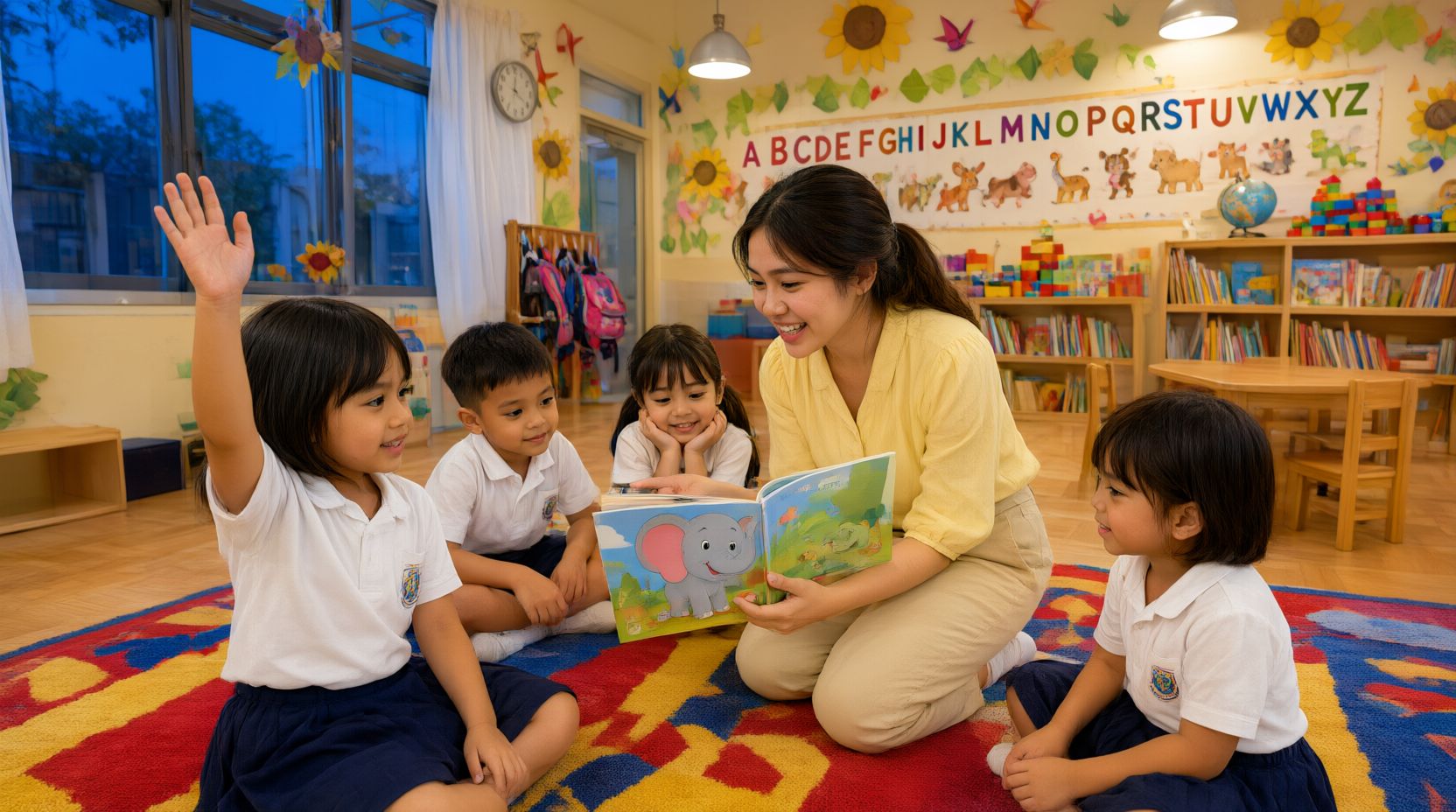
Barangay programs are not part of the DepEd K to 12 ladder. Your child will still enter Kindergarten through the public or private route described above.
A attractive campus and a busy Facebook page are not proof of recognition. For Grade 1 entry and clean record transfers, the level itself must be recognized — so verify the Kindergarten level, not just the school name.
Ask which levels are recognized. A school may be recognized for Kindergarten and elementary, or only for some levels. Ask specifically about Kindergarten.
Ask to see the recognition or permit. Request the document for the level your child will enter, and note the level and school name written on it.
Cross-check with the DepEd division office. Your city or division office can confirm the school's status. Check the latest DepEd issuance at deped.gov.ph for the current process.
Ask about LIS and the LRN. A recognized Kindergarten enrolls learners in the Learner Information System and issues a Learner Reference Number. Ask when this happens after enrollment.
Ask about records. Confirm what your child will receive at the end of the year — a moving-up certificate and the school record (SF10, formerly Form 137) that the next school will ask for.
If you are moving between schools, regions or countries, ask both schools what they need in writing before you withdraw. Keep copies of the report card, the school record and the LRN.
Hanap na ng malapit na preschool. Start with your barangay and your real drop-off commute, then widen to your city and region only if you need to. Every listing links out to the school's own website and map pin so you can verify details at the source.
Filter Preschool & Kindergarten listings by region, city/municipality and barangay, then narrow by sector and schedule.
Browse preschools & kindergartensAnswer a few questions about your child's age, your location, your schedule and your budget, and get a shortlist to visit.
Take the School Finder quizDescribe your situation in your own words — a shift-work schedule, a mid-year move home, a child who needs more support — and get suggested options to check.
Ask the AI School RecommenderAdd up to 3 schools side by side to compare sector, levels offered, schedule and published fee information before you book visits.
Compare SchoolsListings are based on the DepEd school masterlist and public Google Maps data. Where a Google rating is shown, it is labelled exactly as: Google Maps rating · as of Nov 2026. Where no rating is available, the card shows: No Google rating yet. Fee figures appear only when verified; otherwise you will see "Fee ranges being compiled — check with the school directly". Paid or premium profiles do not change search ranking or recommendations. Skoolopedia is free for parents.
Parents in your barangay are searching right now. Keep your listing accurate — levels offered, session hours, location pin and your official website — so families arrive with the right expectations. Claiming or adding a listing is done through Skoolopedia's own forms.
No. Nursery and Pre-Kinder are optional. Kindergarten is the required year before Grade 1 under DepEd's K to 12 program.
Kindergarten has no tuition fee in public schools. Families still budget for uniforms, supplies, snacks and transport, and some schools have voluntary contributions. Private Kindergarten charges fees set by the school.
Children normally start around age 5, but DepEd sets an age cut-off for incoming Kindergarten and Grade 1 each school year and publishes the exact date in its enrollment issuance. Confirm the current cut-off with the school or your DepEd division office, and check the latest DepEd issuance at deped.gov.ph.
Schools typically advise waiting for the next school year or continuing in preschool. Ask your school or division office what applies to your child's birth date for the coming SY.
Kindergarten is required before Grade 1. If your child has not attended Kindergarten — for example, after arriving from abroad — ask your DepEd division office about the assessment and placement process, and check the latest DepEd issuance.
No. Barangay child development centres are care-focused, usually LGU-run with DSWD/ECCD support, and sit outside the DepEd K to 12 ladder. Preschool and nursery are mostly private and prepare children for Kindergarten through structured play.
Ask which levels are recognized, request the recognition or permit for Kindergarten, cross-check with your DepEd division office, and confirm that your child will be entered in LIS and given an LRN.
We publish fee ranges only when verified. Where a figure is not yet available you will see "Fee ranges being compiled — check with the school directly". Ask every school for its complete schedule of fees in writing, in PHP, including items not in the brochure.
No. Ratings are one public signal, shown with their source and date — Google Maps rating · as of Nov 2026 — or "No Google rating yet" when none exists. Visit the classroom, ask about ratios and fees, and check recognition before deciding.