

Your child doesn't need to know their dream job to pick the right SHS track. They need two years of evidence about how they actually work — and most of it is already sitting in your drawer of report cards. This guide shows you how to read that evidence, turn it into a two-strand shortlist, and test the shortlist against real schools before you pay anything.
The strengths-first method in brief
- Read Grades 8–10 report cards down each subject column, not across quarters — patterns beat single grades.
- Separate skill (what they can do), interest (what they choose freely) and stamina (what they can sustain). A track needs at least two of the three.
- Match a cluster of behaviours to a strand, not one favourite subject — and keep two candidates.
- Pressure-test both against actual schools: offering, subject load, full-year fees, commute, support.
- Set a check-in for the end of Grade 11's first quarter, so the decision has a safety net.
Why "What do you want to be?" is the wrong first question
Most families pick a strand through one of three shortcuts, and each one misfires in its own way:
- The barkada decides. Your child follows their friends into a strand chosen for company, not fit — and friend groups reshuffle by Grade 11 anyway.
- STEM because it "sounds smart." The label carries prestige, but prestige doesn't sit the problem sets. A child who dislikes the daily grind of computation and lab work will feel it every week for two years.
- Whatever the nearest school advertises. Convenience masquerading as a decision. The school's marketing budget is not evidence about your child.
Here's the premise this guide runs on: at 15–16, career ambition is unstable, but working habits are already visible. That's not just a hunch. A longitudinal study of adolescents' aspirations, published in 2019 and indexed by the National Library of Medicine (PMC), found that 35.74% of adolescents changed their occupational aspiration from one year to the next, with only modest year-to-year stability. Meanwhile, how your child attacks a hard problem, handles a deadline, and behaves when nobody is grading them — that's observable, repeated, and far more reliable than a stated dream job.
So we separate three inputs throughout this post:
- Skill — what they can already do, shown in grades and outputs.
- Interest — what they choose voluntarily, with no grade attached.
- Stamina — what they can sustain for two years without burning out.
A workable track match needs at least two of the three. Skill alone produces a competent, miserable student. Interest alone produces an enthusiastic, struggling one.
One reassurance before we start: a strand shapes the subjects and assessments your child sits for two years — it is not a permanent career sentence. But changing later has a real cost in time and catch-up work, which we cover below. And one caution: the SHS curriculum itself is in transition. The site's guides note that the Strengthened SHS Curriculum starts SY 2025–26, and DepEd memorandum DM-48, s. 2025 confirms that for SY 2025–2026 it was implemented in Grade 11 only, as a pilot. Which structures and strand names apply to your child's exact school year is something to confirm with each school — read our Senior High School Tracks & Strands guide for the full picture rather than treating any list, including this one, as fixed forever.
The plan from here: build a profile → map it to a shortlist → pressure-test against schools → monitor after enrolment.
Build a strengths profile from two years of evidence, not one card
This is a weekend of observation, not a personality quiz. Work through it with your child, not about them.
- 1
Lay the cards side by side — put the Grade 8, 9 and 10 report cards on the table and read down each subject column, not across each quarter. You're hunting for a two-year pattern, not one bad quarter under one teacher.
- 2
Separate effort from outcome — a 90 in Math earned with nightly tutoring signals different stamina than a 90 earned by a child who does extra problems for fun. Note which subjects your child needed rescuing in, and who did the rescuing.
- 3
Mine the non-numeric evidence — teacher remarks, performance-task outputs, club roles, Science Fair or Buwan ng Wika participation. In group work, did they lead the slide deck, build the prototype, or present? Each is a different strength.
- 4
Log one week of unprompted behaviour — what they watch, what they fix, what they argue about at dinner. Do they reorganise their allowance or their game inventory? Do they explain things to siblings? Nobody assigns this behaviour, which is exactly why it counts.
- 5
Ask three specific questions — instead of "anong gusto mo?", ask: Which class period passes fastest? Which role do you always end up taking in group tasks? Which subject would you drop first if you could? Specific questions get honest answers.
- 6
Write one page, three columns — consistent strengths, genuine interests, and friction points: subjects that drain them and formats they struggle with (timed computation vs. oral defence vs. hands-on demo). This page becomes the reference for every later decision.
A low grade isn't always a weakness
If your child has never been properly taught a subject — a rotating cast of teachers, a semester of cancelled classes — a low grade there is a teaching gap, not a verdict on ability. Mark it "untested" on your profile instead of ruling a strand out because of it.
Turning strength clusters into a two-strand shortlist
Don't match one favourite subject to one strand. A child who likes Math might belong in STEM, ABM or a TVL specialisation — the subject alone can't tell you. Match a cluster of two or three observed behaviours from your profile, and keep two candidates so the decision stays open until you've seen actual schools.
| Strength cluster you observed | Candidate strand | What to double-check |
|---|---|---|
| Enjoys abstract problems, tolerates repetition and precision, comfortable being wrong on paper | STEM | Do they enjoy the process of solving, or only the prestige of the label? |
| Organises people and things, tracks money, persuasive, likes measurable outcomes | ABM | Real initiative: running the sari-sari store till, reselling, budgeting a school event, leading a fund-raiser |
| Reads and writes voluntarily, argues a position, notices people's motives, comfortable speaking | HUMSS | The child who drafts the group's script, mediates fights, or writes long posts about issues |
| Genuinely broad, competent across subjects, still undecided | GAS | Is breadth a deliberate strategy, or avoidance of choosing? |
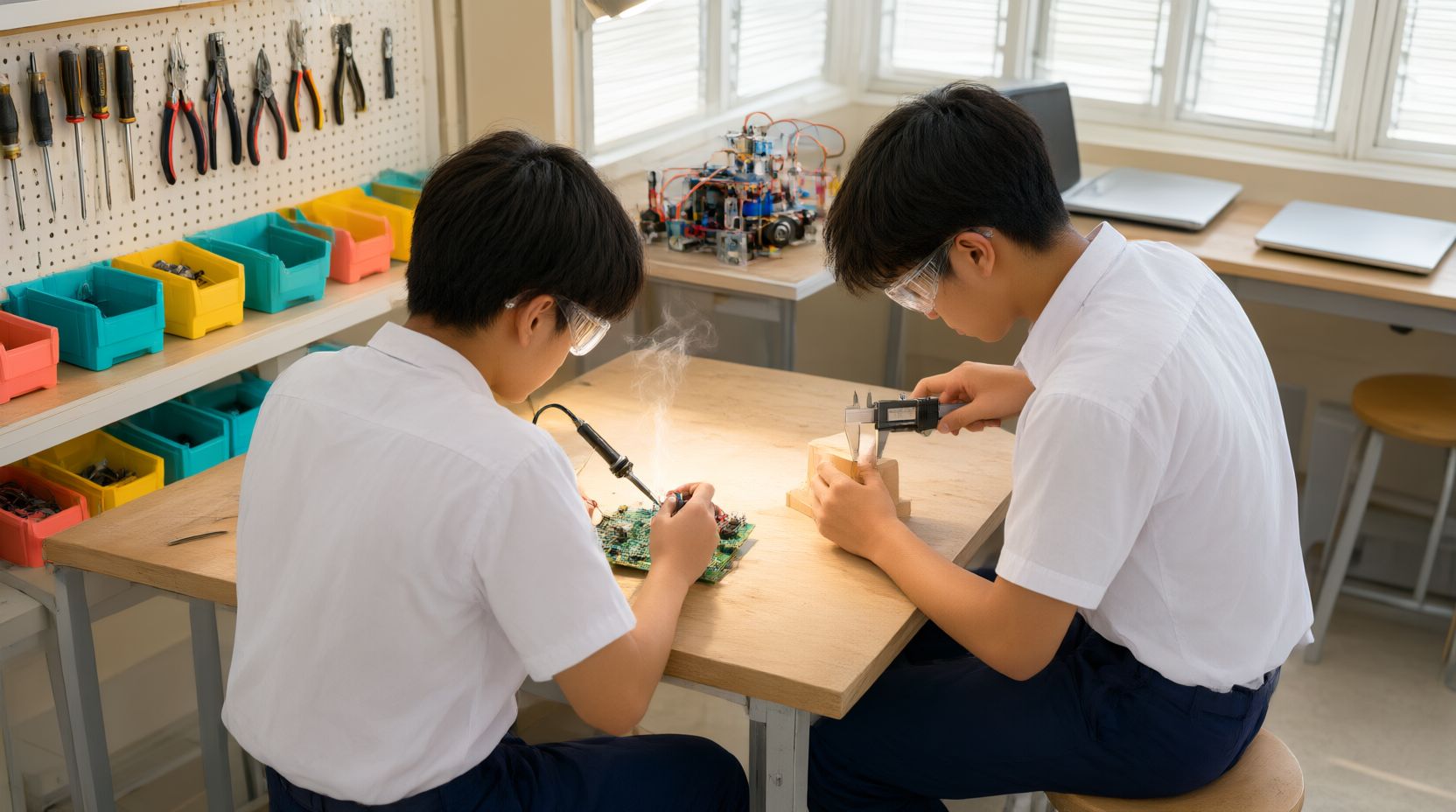
| Learns by making, repairing, cooking, wiring, coding, growing | TVL | Which specialisation, exactly — and does the school's workshop actually support it? |
Two clusters deserve extra words. GAS works best as a deliberate holding strategy for a genuinely broad, undecided student — the trade-off is breadth and flexibility in exchange for less depth in any one field, and that trade should be chosen, not defaulted into. TVL is never just "TVL" — insist on choosing the specialisation, because the day-to-day experience varies enormously between specialisations and between schools' workshops. Ask each school which specialisations it actually runs and what the current curriculum calls them; don't assume from the track name alone.
Three cross-cluster cases worth pausing on
- Strong in Math, hates writing. STEM still demands research papers and defences. Check the friction column of your profile before assuming numbers-only comfort is enough.
- HUMSS-leaning, weak English grades, strong oral reasoning. Look again at step 2 — is the grade an effort problem, a teaching gap, or a written-format problem? A child who argues brilliantly at dinner may simply be untested in essay format, not unsuited to HUMSS.
- Hands-on strength read as academic weakness. Some parents treat a TVL-leaning child as one who "can't handle academics." Making, repairing and troubleshooting are skills, not consolation prizes — and a well-chosen specialisation can demand plenty of theory.
The rule for the shortlist: write one sentence of evidence for candidate 1 and one for candidate 2. "She has budgeted her allowance and two school events for three years and enjoys negotiating" is evidence. "He seems smart" is a wish. If you can't cite the evidence, it's not a match yet.
Pressure-test the shortlist against schools, money and logistics
A shortlist is a hypothesis. Schools are the experiment. It's worth checking each candidate against five realities before enrolment — a track only exists where a school actually offers it, and two schools using the same track label can differ a great deal in depth and facilities.
Reality check 1 — availability. Verify the actual offering per school rather than trusting a track name in an ad. Our directory lets you filter by region, province, city/municipality and barangay, by Senior High level, by SHS track and by ESC / SHS Voucher participation — free, no sign-up. Start with the School Finder Quiz to build a nearby list, then confirm each offering with the school directly: listings combine the official DepEd masterlist and public programme lists, and details change.
Reality check 2 — the subject list. Ask each school for the actual SHS subject load and assessment format for the strand, plus the work-immersion arrangement. Then hold that list against your child's friction points. A strand heavy on timed computation is a different proposition for a child whose profile flags timed tests as draining.
Reality check 3 — money. Ask for the full year's schedule of fees, not the headline tuition: miscellaneous fees, laboratory and materials fees, tools and PPE where a specialisation needs them, uniforms, project materials, any certification assessments. We don't publish typical strand-cost figures because we haven't verified them from an authoritative source — the school's own fee schedule is the number that matters. On government support: the SHS Voucher is a State subsidy for qualified Grade 10 completers enrolling in a non-DepEd SHS of their choice, as defined in DepEd Order No. 16, s. 2020. The voucher amounts in that 2020 order are not confirmed as current, so verify today's amounts and your child's eligibility with PEAC and the school before budgeting around them — our ESC and SHS Voucher Program guide explains how the two programmes differ and where to check.
Reality check 4 — logistics. Count the commute honestly. A two-hour each-way commute plus a heavy problem-set strand is a stamina question, not a discipline question — and stamina is one of your three inputs.
Reality check 5 — two blunt questions for the school. What share of students in this strand shift or struggle in Grade 11? And what support exists for a student who arrives weak in one prerequisite subject? A school that answers concretely is telling you something valuable; a school that bristles is telling you something too.
Then make the trade-offs visible instead of argued about. One row per strand-per-school:
| School + strand | Subjects & specialisation offered | Total annual cost (from fee schedule) | Commute (each way) | Support for weak prerequisites |
|---|---|---|---|---|
| School A — candidate 1 | (from the school) | (from the school) | (your measured route) | (their answer) |
| School A — candidate 2 | ||||
| School B — candidate 1 | ||||
| School B — candidate 2 |
Fill it with what schools actually tell you — leave nothing to memory or marketing. When the sheet is full, the family conversation gets much shorter.
If the fit is wrong: early signals and the real cost of switching
Even a careful match can misfire. Watch the first quarter of Grade 11 for signals specific to the strand — not general adolescent mood:
- Dread aimed at the strand's core subjects specifically, while the rest of school feels normal.
- Grades dropping only in track subjects while core subjects hold steady.
- Avoidance of the strand's performance tasks — the lab report, the business plan, the demo.
- Your child saying they "don't see the point" of the specialisation.
Distinguish misfit from adjustment. A hard first quarter in a demanding strand is normal — everyone climbs a learning curve. The signal to act is a consistent pattern across two quarters plus loss of interest outside school.
What to do first, in order: talk to the subject teacher, then the adviser, then ask about remediation or bridging support — before asking about transferring. Many "wrong strand" situations are really one unsupported prerequisite subject, and that's fixable in place.
If a switch genuinely is needed, go in with clear eyes. We haven't verified DepEd's current rule text on mid-SHS shifting, so ask the school and your DepEd division office directly what's allowed, what catch-up subjects it requires, and whether it can happen between Grade 11 and Grade 12 or only via a new school. What we can show you is that the cost of arriving from a different strand is real: the Technological University of the Philippines' published admissions requirements state that for its engineering programs, SHS STEM graduates need no grade lower than 80% in Mathematics, Science, English and GPA, while graduates of other tracks need at least 85% in those subjects and take bridging programs embedded in the curriculum (TUP admissions requirements). That's one institution's published policy, not a universal rule — but it illustrates the pattern: a strand mismatch tends to be paid for later in extra subjects, time and money. Which is exactly why two weekends of observation now are worth it.
A two-weekend plan — and letting your child own the answer
Here's the whole method on a calendar:
- Weekend 1 — build the profile together. Cards on the table, one week of behaviour logged, the three questions asked. End the weekend with the two-strand shortlist and its evidence sentences written down.
- Weekend 2 — test it against schools. Visit or call two schools per shortlisted strand, fill the comparison sheet, and check the full fee schedule and voucher eligibility.
- One 30-minute family conversation, fixed agenda: your child presents the shortlist and reasoning first; you add constraints (budget, commute, safety) second; decision or tie-breaker last.
Give your child language that keeps them in charge. "Here's what I noticed you're good at — does that match how you feel?" opens a conversation. "You should take STEM" closes one. The failure mode of a parent-chosen strand is familiar to many advisers: two years of compliance, then a shift request in Grade 12 — the most expensive possible moment to discover the fit was never theirs.
Finally, set a review date: the end of Grade 11's first quarter, revisit the misfit signals together. A decision with a scheduled check-in is easier for a teenager to commit to, because it isn't a life sentence — it's a choice with a safety net.
Still need the basics before the observation work? Our step-by-step track-choice walkthrough covers the fuller decision process. And once you've written your child's two-strand shortlist, keep the page — you'll want it in hand after the school visits, when the evidence meets reality.
Ready to pressure-test the shortlist?
Filter real schools near you by SHS track, location and voucher participation — free, no sign-up, no paid placement in results.
Find schools offering your shortlistSources
- Department of Education — DM-48, s. 2025, Pilot Implementation of the Strengthened SHS Curriculum (2025)
- Department of Education — Order No. 16, s. 2020, SHS Voucher Program (2020)
- National Library of Medicine (PMC) — longitudinal study of adolescents' occupational and educational aspirations (2019)
- Technological University of the Philippines — admissions requirements (2025)
